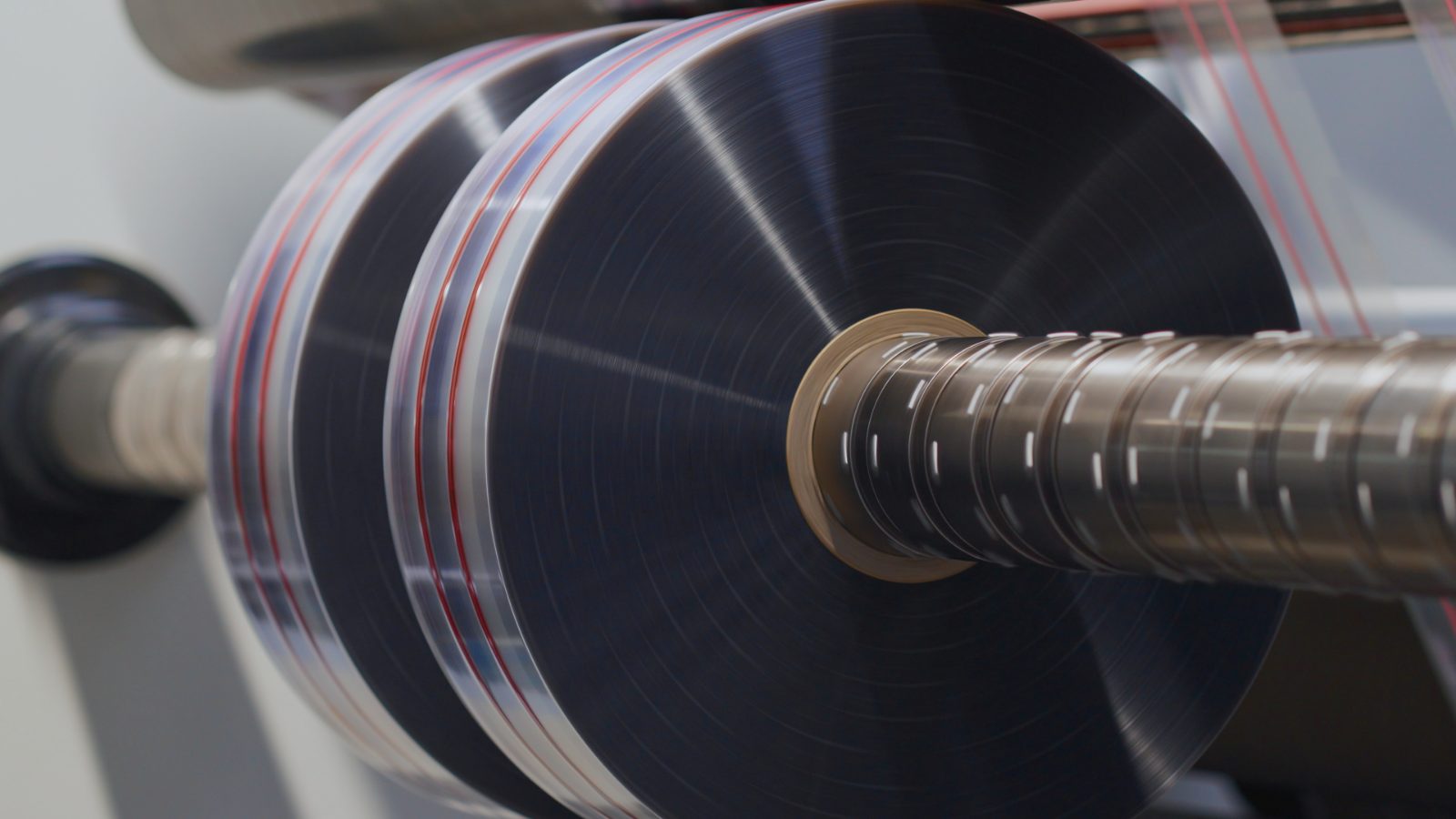
Why film slitting affects VFFS/HFFS and flow-pack
Even superbly printed and laminated material will not run if the edge is 'frayed', the reel telescopes or there is play on the core. Precise film slitting guarantees an even web path, a repeatable seal and even bag 'shoulders'. The result? Fewer operator adjustments, shorter start-ups and a higher running speed.
Slitting technologies — matching the tool to the material
We work with three families of solutions: razor blades (a very clean edge on thin BOPP/PET), shear knives (high quality on thicker and 'harder' laminates) and score cutting, where economy and thickness range matter. The choice is decided by the type of film, the thickness, the target web width and the requirements of the customer's line.
Slitting PET film — specifics and good practice
Slitting PET film requires precise tension control and very sharp cutting edges. PET is stiff and 'springy', so poorly chosen settings can cause micro-cracking of the edge or 'flow' of the wind. That is why we stabilise web guidance, control pressure and speed, and carry out the winding with a force that keeps the reel even, without coning or slack.
Order parameters — what is worth agreeing before slitting
• Target widths (in millimetres) and tolerances.
• Thickness and type of raw material (BOPP/CPP/PE/PET, laminates).
• Core diameter and wind direction (typically 3″; others on request).
• Maximum reel diameter/weight for your unwind.
• Packing and labelling (traceability, code, batch, running length).The more precise the specification, the shorter your start-up and the lower the risk of rejects.
Typical problems and how we prevent them
• Telescoping — selecting the right wind force and edge guidance.
• 'Soft centre' — pressure control, even distribution of stresses.
• Edge burr — the right choice of knife and more frequent blade changes.
• Electrostatic charges — neutralisation/air blow-off, antistatic slitting conditions.
• Core damage — proper storage and transport, side protection.
Film slitting + print and lamination — one process, one responsibility
When film slitting is integrated with print and lamination, you avoid the records 'drifting apart' and gain full consistency: the proof = what you see on the reel, and the widths and winds are exactly as your unwinds require. For the purchasing department this means a lower total cost; for production — fewer adjustments at the start.
Summary — film slitting and PET film slitting,
If you expect a start with 'no knob-twiddling', choose professional film slitting. For PET projects, stable guidance and a clean edge matter even more, which is why we will select the technology and settings so that your line runs evenly from the very first metre. We will supply reels with widths and winds compliant with the specification, with full traceability and batch documentation.
Take the next step:
• Order a free consultation and a slitting specification (widths, core, tolerances, packing).
• Order samples and a pilot run to confirm how the material behaves on your unwind.
• Get a fast quote with a deadline that keeps to the calendar.
Write or call — we will reply quickly and to the point.
Sounds like your project?
Write or call — our technologist will advise on the structure and quote your volume within 24 hours.
Free quote +48 731 819 963